Key findings
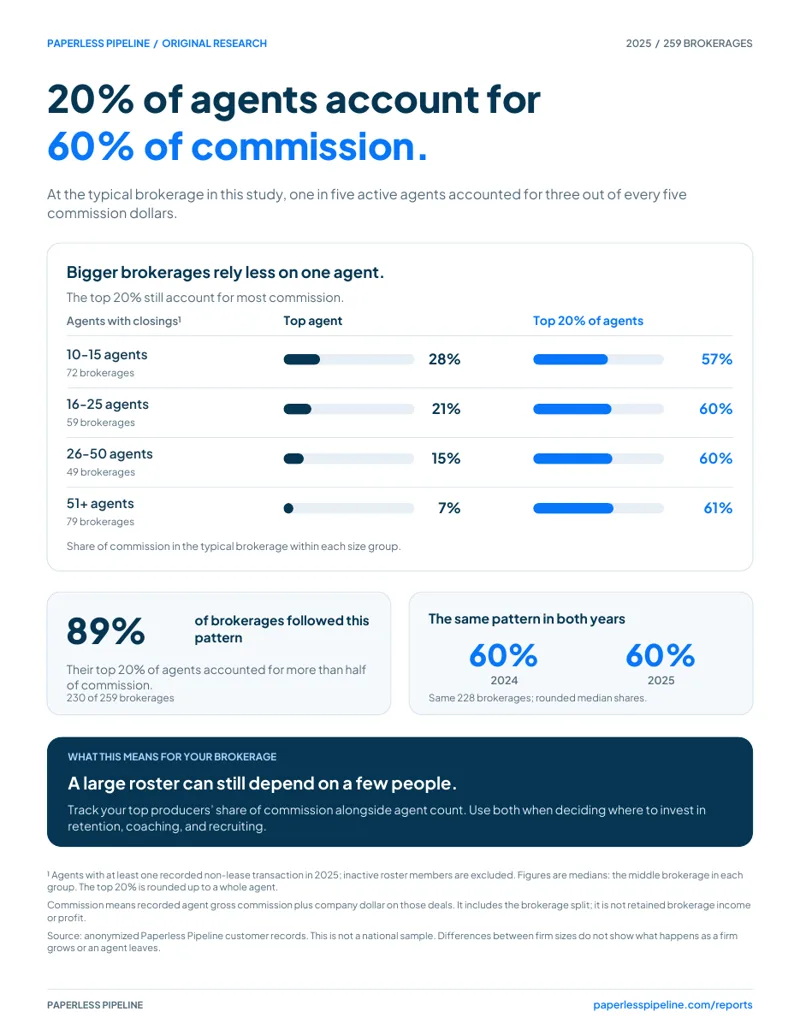
At the typical brokerage in this study, the top 20% of active agents accounted for 60% of 2025 commission.
At 230 of 259 brokerages (89%), the top 20% of agents accounted for more than half of commission.
The single top agent accounted for 28% of commission at the typical brokerage with 10-15 agents, compared with 7% at brokerages with 51 or more agents.
Across the same 228 brokerages, the median top 20% share was 60% in both 2024 and 2025.
03
How many brokerages depend on a small group of top producers?
Most of them. At 230 of 259 brokerages (89%), the top 20% of agents accounted for more than half of commission.
A large roster can still depend on a few people. Track your top producers' share of commission alongside agent count, and use both when deciding where to invest in retention, coaching and recruiting.
Paperless Pipeline
Know what your brokerage keeps.
Track transactions and commissions in the same place.
04
Did agent production concentration change from 2024 to 2025?
No. Across the same 228 brokerages, the median top 20% share was 60% in 2024 and 60% in 2025.
These are rounded median shares for brokerages with data in both years.
Methodology and limitations
Source: Paperless Pipeline customer transaction data. The study covers 259 brokerages with 10 or more agents with closings in 2025, grouped by size: 72 with 10-15 agents, 59 with 16-25, 49 with 26-50 and 79 with 51 or more.
Agents are counted only if they had at least one recorded non-lease transaction in 2025. Inactive roster members are excluded. The top 20% is rounded up to a whole agent.
Commission means recorded agent gross commission plus company dollar on those deals. It includes the brokerage split. It is not retained brokerage income or profit.
Figures are medians: the middle brokerage in each group. The 2024 comparison uses the same 228 brokerages and rounded median shares. Interpret these figures as descriptive observations from Paperless Pipeline brokerages, not the entire US market.
Source report