How to Start a Real Estate Team From Scratch

So, you’re ready to build your own real estate team. It’s a huge step! But what’s the first move? If you think it’s hiring another agent, I want you to pause right there. The most successful real estate teams are built on a strong foundation of systems, not just more sales talent. This guide breaks down how to start a real estate team the smart way. We’ll focus on creating repeatable processes and why your first hire should probably be an admin, not another salesperson. Let’s get your business structured for sustainable success.
It boosts their earning potential and is a low-risk way to develop the skills and experience they’ll need to one day open their own real estate business.
In fact, 80% of realtors claim to be more productive and successful when they’re part of a real estate team, while 76% say that being on a real estate team earns them a higher income.
It can also help busy real estate professionals struggling to maintain a good work-life balance.
But building a real estate team can be difficult. Who should you hire? How much should you pay them? Do you employ transaction coordinators directly or hire a freelancer?
This article explains everything you need to know about starting your own real estate team. It also provides several team structure ideas. Each one suits a different-sized team and way of working.
What Is a Real Estate Team?
Before you start building your team, it’s important to understand what a real estate team is from a legal and regulatory standpoint. While the day-to-day operations might feel like running a small business, most states have specific rules that define what constitutes a team and how it must operate under the umbrella of a larger brokerage. These regulations are in place to protect consumers and ensure clear lines of accountability. Think of it as the official playbook you need to follow to keep your business compliant and professional.
Generally, a team consists of two or more licensed agents who work for the same broker and market themselves under a single team name. This structure allows agents to pool resources, share leads, and support each other’s growth. However, the supervising broker remains ultimately responsible for the team’s activities. Understanding this hierarchy is key to setting up a team that not only thrives but also operates squarely within the legal lines of your state’s real estate commission.
The Official Definition and Rules
Every state has its own specific definition, but the core concept is usually the same. For example, the Connecticut Department of Consumer Protection defines a team as “a group of at least two licensed real estate brokers or salespersons” who work for the same principal broker and advertise together with a team name. This is a pretty standard framework you’ll find across the country. The key elements are multiple licensed professionals, a shared supervising broker, and a collective brand identity. This structure is what legally separates a team from a group of individual agents who simply work in the same office.
Team Composition Requirements
The rules for who can be on a team are also clearly defined to prevent conflicts of interest. Typically, all members must hold an active real estate license in that state. An important distinction made in states like Connecticut is that a principal broker cannot be a member of a team that includes a salesperson or broker they directly supervise. This rule ensures that the lines of supervision remain clear and that the broker’s oversight responsibilities aren’t compromised by being a direct participant in the team’s commission structure.
Legal and Licensing Requirements
Operating a real estate team means you have to follow a specific set of state laws and regulations. These rules govern everything from how you can advertise your team name to how you handle client agreements. For instance, Connecticut teams must adhere to the regulations outlined in Chapter 392 of the state’s laws. It’s crucial to familiarize yourself with your state’s specific requirements. The best place to start is your state’s real estate commission website, which serves as the primary resource for all licensing and compliance information. Staying on top of these rules isn’t just about avoiding fines; it’s about building a reputable and sustainable business.
State Registration Process
In most cases, you can’t just declare yourself a team and start printing business cards. You’ll likely need to officially register your team with the state’s real estate commission. The good news is that this process has become much more streamlined over the years. Many states now require teams to apply for their license online through a dedicated portal. This digital-first approach simplifies the paperwork and makes it easier to track the status of your application, letting you focus more on building your team and less on administrative hurdles.
Application Fees and Renewals
Starting a team also comes with some initial and ongoing costs. You should budget for application fees, which can vary significantly by state. To give you a ballpark idea, the initial application fee in Connecticut is $565, with an annual renewal fee of $375. These fees are non-refundable, so make sure you have all your ducks in a row before submitting your application. Factoring these administrative costs into your business plan from the beginning will help you manage your finances and avoid any surprises down the road.
Understanding Agent Earnings and Career Paths
One of the biggest motivators for starting or joining a real estate team is the potential for a higher income and a more defined career trajectory. The traditional path of a solo agent can be rewarding, but it often comes with income volatility and the pressure of handling every aspect of the business alone. A team structure can provide stability, mentorship, and opportunities for specialization that lead to greater financial success. By sharing the workload, agents can focus on their strengths—whether that’s lead generation, client care, or closing deals—which often results in more transactions and higher overall earnings for everyone involved.
Beyond the immediate financial benefits, being part of a team can accelerate your professional development. New agents can learn the ropes from experienced veterans, while seasoned agents can step into leadership roles, honing the skills they’ll need to eventually become a broker or even open their own brokerage. This collaborative environment fosters growth and creates a clear path for advancement that might not be as accessible to a solo agent. It’s about creating a system where individual success contributes to the success of the whole group.
How Real Estate Commissions Work
Unlike salaried positions, most real estate agents work on a commission-based model. As Colibri Real Estate explains, an agent’s income is typically a percentage of a property’s final sale price. This commission is negotiated between the seller and their listing agent and is then split among the agents and brokers involved in the transaction. This performance-based pay structure means your earning potential is directly tied to your ability to close deals. For a team, this structure becomes more complex, with additional splits between the team lead and team members, which should be clearly outlined in your team agreement.
A Typical Commission Split Example
Let’s break down the numbers with a real-world example. Imagine a home sells for $754,304 with a total commission of 5.14%. That amounts to $38,771 in total commission. Typically, this amount is split down the middle between the buyer’s brokerage and the seller’s brokerage, leaving each with $19,386. From there, each agent gets a portion of that amount based on their split with their broker. On a team, another split occurs, where the agent shares a part of their commission with the team lead in exchange for leads, marketing, and support. This is where having a dedicated system to manage commissions becomes essential, ensuring everyone gets paid correctly and on time.
Average Real Estate Agent Income
So, what does this all translate to in terms of annual income? It varies widely based on several factors, but the potential is significant. In a competitive market like California, for example, annual salaries for real estate agents can range from around $84,000 to well over $200,000. This wide range highlights just how much an agent’s income depends on their individual effort, market conditions, and business strategy. Joining a team can often place agents on the higher end of this spectrum by providing them with more opportunities and support than they would have on their own.
Key Factors That Influence Earnings
Your income as a real estate agent isn’t set in stone. Several key factors can influence how much you make. Your level of experience plays a huge role; seasoned agents with a strong track record tend to command higher earnings. The location of your market is another major factor, as commission rates and property values can differ dramatically from one city to the next. Finally, the number of hours you put in directly impacts your output. Real estate is not a passive career, and your dedication is often reflected in your paycheck.
Strategies to Maximize Your Income
Whether you’re a solo agent or part of a team, there are proven strategies you can use to increase your earning potential. It’s not just about working harder; it’s about working smarter. By focusing on building a strong professional network, developing a specialized niche, delivering exceptional client service, and committing to ongoing education, you can create a powerful engine for sustainable growth. These strategies work together to build your reputation and attract a steady stream of high-quality clients, which is the ultimate key to a long and prosperous career in real estate.
Build Your Network
Your network is your net worth in real estate. Actively participate in local community events and join professional organizations to meet new people. Building strong relationships with professionals in related fields, like mortgage lenders and home inspectors, can also lead to a steady stream of referrals. The goal is to become a well-known and trusted name in your community, so when someone thinks of real estate, they think of you first.
Develop a Niche Specialization
Instead of trying to be a jack-of-all-trades, consider becoming an expert in a specific area. You could specialize in luxury homes, first-time homebuyers, investment properties, or a particular neighborhood. Developing a niche allows you to focus your marketing efforts and build a reputation as the go-to expert in that segment. This specialization can attract more serious, higher-paying clients who are looking for your specific expertise.
Prioritize Client Satisfaction
Happy clients are the foundation of a successful real estate business. They lead to five-star reviews, repeat business, and valuable referrals. Make it a priority to provide excellent customer service by being responsive, proactive, and going the extra mile to meet their needs. A smooth and positive experience will ensure your clients become your biggest advocates, helping you grow your business organically.
Pursue Continuing Education
The real estate industry is always changing, with new laws, technologies, and market trends emerging all the time. Committing to continuing education keeps you sharp and informed, allowing you to provide the best possible advice to your clients. For example, prospective agents in California must complete 135 hours of pre-licensing coursework. But the learning shouldn’t stop there. Staying updated demonstrates your professionalism and commitment to your craft.
The Real Estate Career Path
For many agents, the career path doesn’t end with joining a team. The experience gained from working in a collaborative environment often serves as a stepping stone to the next level: becoming a real estate broker. This transition involves more rigorous training and licensing requirements, but it also opens the door to greater autonomy and higher earning potential. A broker can legally manage other agents, run their own brokerage, and handle transactions independently, making it the ultimate goal for many ambitious real estate professionals.
Agent vs. Broker Licenses
The distinction between an agent and a broker is a crucial one. A real estate agent (or salesperson) must work under the supervision of a licensed broker. A broker, on the other hand, has completed additional education and has more experience, allowing them to operate their own business and supervise other agents. As a result, brokers typically have a higher earning potential and more control over their careers. For many team leads, obtaining a broker’s license is the logical next step in their professional journey.
Is It Time to Start Your Real Estate Team?
Deciding to build a real estate team isn’t a decision to take lightly. You’ll be responsible for other team members’ livelihoods and have to start managing people.
There are a number of factors to consider that can be grouped into three main categories:
Is Your Sales Volume High Enough?
The first factor to consider is whether you are making enough sales to justify starting a real estate team.
Most agents can comfortably handle roughly one transaction per week. However, to justify employing someone, you need to make at least 30 deals annually—with this number set to increase.

Ask yourself, “Is my lead generation suffering because I spend too much time managing clients?” If the answer is “yes,” it’s time to recruit new team members.
You should also check the going rate for staff and whether your business finances could absorb the cost to ensure you can afford to employ new team members.
On the upside, hiring new team members may improve your sales volume. The right hires—like a transaction coordinator, for example—can help ensure you close more deals.
They can also help make sure nothing falls through the cracks. This means you won’t lose out on any deals because you weren’t on top of things like paperwork and transactions.
Are You Ready to Be a Leader?
When starting a real estate team, you’ll have to be the team leader. Many agents are unprepared for the level of professional transformation required to do this.
You can’t simply hire someone and expect them to start generating leads and commissions for you.
As a team leader, you’ll need to:
- Be ready to develop a real estate team business plan.
- Hold each team member accountable for meeting targets and fulfilling their roles.
- Mentor your real estate team and help them develop their skills and careers.
- Help solve problems in the team.
- Be tough yet empathetic.

If you believe you have what it takes to be the kind of team leader that propels your business forward and gives your employees the support they need, it may be time to invest in new recruits.
Why Do You Want to Start a Team?
You should also consider why you want to start a real estate team, what you want to achieve, and where you want it to go.
Here are some common reasons why real estate professionals want to start their own teams:
You’re a high-performing agent
If you bring in more leads than you can handle, starting a real estate team is a great way to boost your earning potential.
It’s also helpful if you struggle with certain aspects of your role. For example, if a situation develops where deals might start falling through due to missed deadlines, you would probably benefit from having a transaction coordinator on your team.
Being a high-performing agent may also mean you don’t have the time to focus on building and growing a business.
Hiring new team members could help you balance the workload of being a successful agent and having time to get a business off the ground.
Work-life balance and family are important to you
If you want to spend more time with your family, starting a real estate team is a good way to share some of your workload with others.
You could even make your real estate team a family business. Many real estate teams have a husband-and-wife or parent-and-child partnership at their core.
Additionally, being a real estate agent is notoriously time-consuming and demanding, and this may result in you having less time for your personal life.
Hiring a team might be the answer if you feel it’s time to achieve a better balance between work and life. Having more people on board to handle your work responsibilities gives you more time to focus on other aspects of your life.
You want a more convenient arrangement
Some real estate teams come together naturally. Perhaps two agents working in a highly competitive niche decide to collaborate to gain a larger share of the market.
Or maybe two agents have been sharing leads for some time, and it makes sense for them to start working together.
If you already have a relationship with at least one other agent, it may make sense to start a business with them and grow your team together.
3 Essential Rules for New Real Estate Teams
There are a few common mistakes that many real estate teams make when starting out. This section provides three tips to help you avoid these pitfalls.
1. Make Lead Generation Your Top Priority
Your real estate team must be a lead-generation machine from day one. Otherwise, it won’t be successful.
Think about it: why would good agents want to join your real estate team if they won’t be getting more sales opportunities than they would from working alone?
Additionally, if you employ people and pay wages, then you need to keep revenue flowing. Your agents should have a constant flow of leads so they are always working at maximum capacity.

If you’d like some ideas on how to generate more leads for your new real estate business, read our full lead generation guide.
2. Build Solid Systems and Operations
Most real estate teams are divided into two distinct sections: operations and sales.
Operations consist of back-office support, such as admin staff and transaction coordinators. Sales are the people who go out and meet clients—like your agents and showing assistants.
Most agents make the mistake of immediately taking on new sales staff when starting their own real estate team.

They do this because it’s less risky than employing admins. Real estate agents only get paid once they make deals, whereas admins need to be paid from day one—whether you are making sales or not.
3. Transition From Agent to Leader
Some agents start a team for the sole purpose of generating leads for themselves and boosting their own sales.
This makes sense—selling is an agent’s natural instinct. But you’ll struggle to retain a good team of agents if you do this.
You need to start thinking like a team leader for your team to succeed. Here’s the approach you should take:
Start handing leads to agents
Do this regularly to ensure they get more from you than they’d generate alone. Additionally, making agents responsible for handling leads frees up your time to build a successful business.
Be a mentor
You need to train team members regularly to do their jobs better. Share the knowledge that has made you become a high-performing real estate professional.
Identify your goals
Provide targets and nurture accountability to keep your team productive and focused.
The right software will not only help you manage commissions and transactions, but also give your team members access to their production reports so that they can see how they’re performing and what areas to improve.
How to Structure Your Real Estate Team’s Commission Split
When building a new team, the big question is how much you should pay staff and agents. Generally, the more back-office support staff you have, the lower the agent commission is.

That’s because the real estate agent will be charged a higher brokerage fee on their gross commission, which pays the support staff’s salaries.
The trade-off is that agents with good back-office support should be able to handle far more deals, and so their potential earnings are higher.
You should spend around 12% of your gross commission income on your admin roles.
To make calculating commission a breeze, check out our commission split calculator. Investing in our Commission Module can also make commission splits far more manageable in your new business.
6 Common Real Estate Team Models
Before you start recruiting new team members and deciding how you’ll pay everyone, you need to decide how you’ll structure your business.
This determines how you will run your business and the respective responsibilities of your new team members.
Below, we outline six successful real estate team structures so you can choose one that best suits you.
The first two on our list are ‘starter structures.’ These are aimed at agents starting a team from scratch. The others are larger team structures that you may wish to work toward.
1. The Small Traditional Model
This real estate team structure is the usual way agents start a team. You’ll act as a team leader and direct operations and sales.
If you are in a partnership with another real estate agent or family member, you could act as lead agents together.
This real estate team structure, like any other, will typically take time to implement and become fully operational. It would look like this:
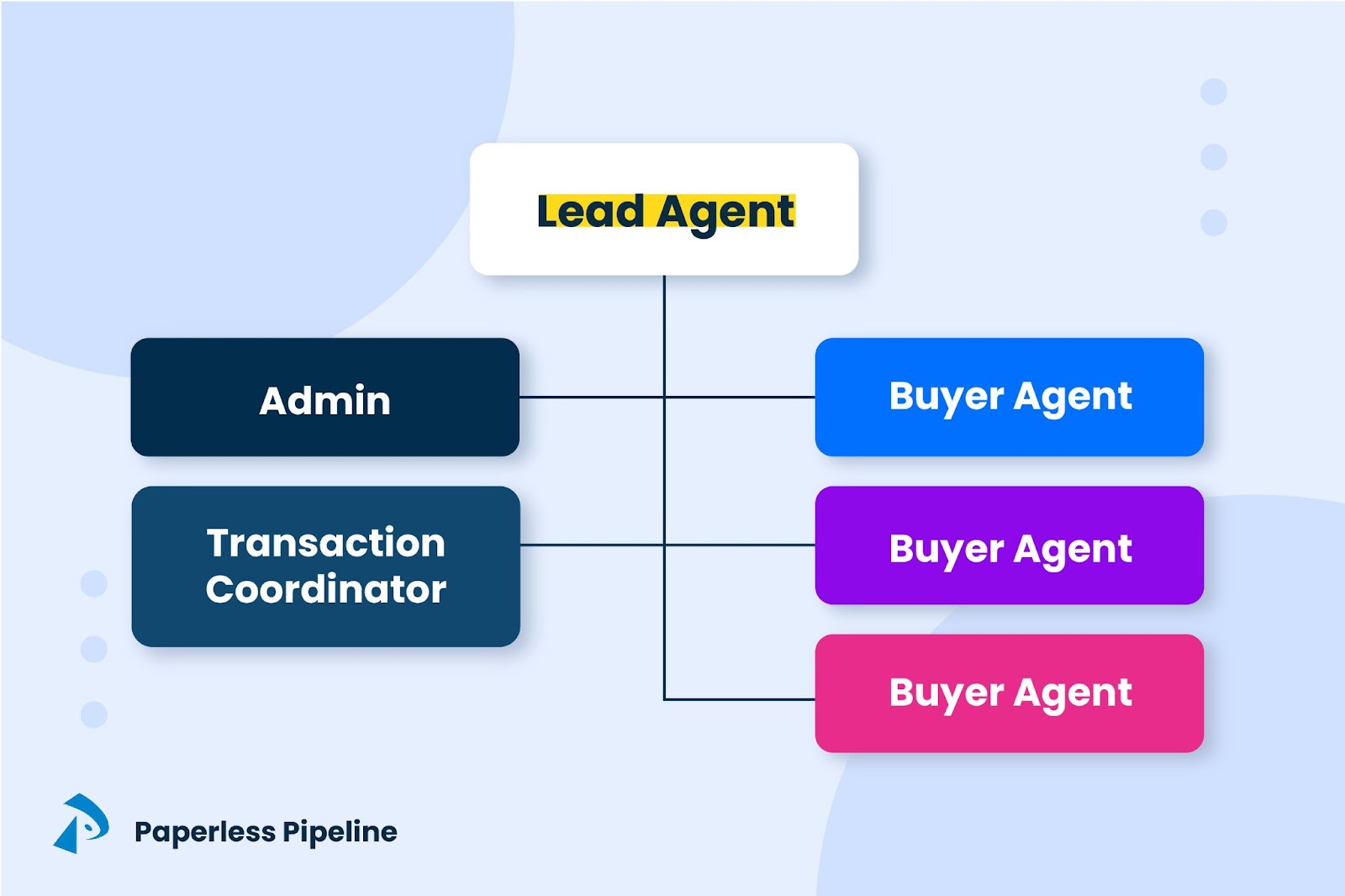
Here’s the order you should follow to set up this type of structure:
- Hire an admin to handle listings, contracts, closing, and all the paperwork in between. This frees you up to do more sales and generate more leads.
- Soon, you’ll be producing more leads than you can handle. Now, it’s time to bring in your first buyer agent. You will act as the listing agent.
- When you produce more leads than you and your buyer agent can handle, hire a transaction coordinator. They don’t have to be licensed to begin with. They can take over the paperwork.
- After some time, you’ll again have more leads than you can handle. Now, it’s time to hire more buyer agents. You’ll continue to handle listings.
- This model could continue to grow indefinitely. However, if you find that you are getting more listings than you can handle, it might be worth considering one of the larger real estate team models described later in this guide.
Commission Split
This real estate team structure is admin-heavy; therefore, you’ll need a commission split of around 50/50.
For this to be profitable for your agents, you must ensure that your admins and transaction coordinators handle as much of the process as possible.
Pros
- Handing off the admin tasks makes agents more productive.
- You can focus on high-value listings.
- Excellent growth potential.
Cons
- You’ll need to generate a steady stream of leads to pay staff wages.
- More experienced agents won’t want to be limited to buyer deals and lower commission rates.
- It might not be suitable for a low-volume real estate market—for example, in rural areas.
2. The Mentor-Mentee Model
The mentor team structure model is an alternative to the traditional structure in that it is less risky because you don’t employ anyone directly, but you take home a cut of their commission in return for providing them with guidance and expertise. It’s typically a fairly informal arrangement agreed upon by the parties in question.
An experienced real estate agent supports a small number of inexperienced agents. These recruits usually leave after a couple of years for a team or brokerage that offers them better terms.
The mentor structure would typically look like this:

Each real estate agent is usually responsible for generating their own leads, doing the related paperwork, and closing deals.
The mentor usually provides advice, support, targets, and commission payments. There is no admin or transaction support.
Commission Split
Under the mentor structure, agents are responsible for their own admin. The team leads provide minimal input. Therefore, we suggest a split of 10/90 (team leaders/agents).
Pros
- It will be easy to earn extra commissions for much less work.
- This structure is low-risk.
- It’s also low-cost.
Cons
- It comes with poor scalability.
- There’s a relatively low production rate.
- Your best real estate agents may quickly move on to bigger brokerages.
3. The Expanded Traditional Model
If your small traditional structure has reached 300 transactions (or more) and you have more listings than you can handle on your own, then it might be time to expand your team further.
An expanded traditional structure will see you hand your listings over to another agent. You’ll now have two sides to your sales team. One handles listings, one handles buyers.
Your structure may look like this:
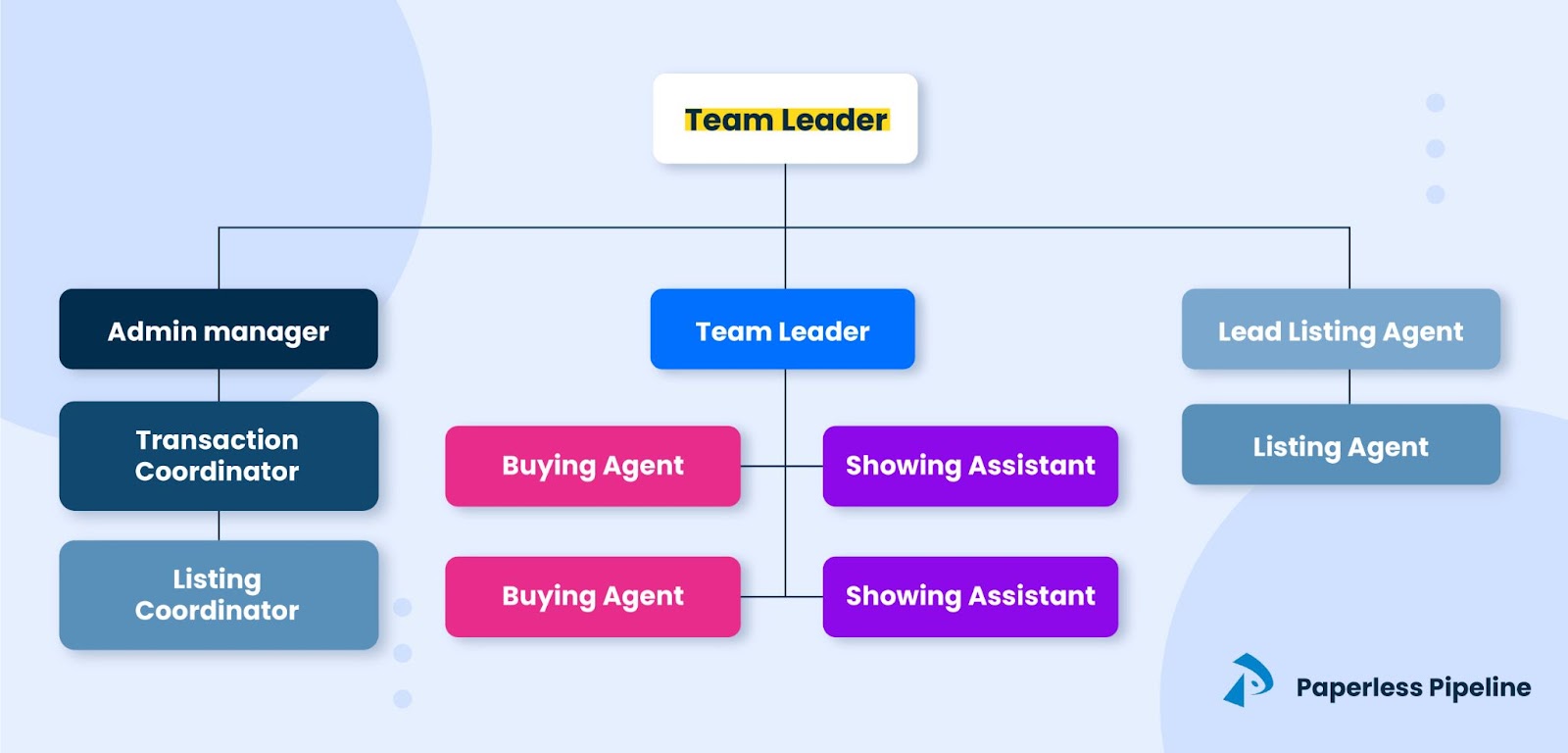
Each buying agent is supported by a showing assistant. Showing assistants are typically young or inexperienced people looking to take their first step into the real estate industry.
With enough training and by passing the relevant exams, showing assistants can eventually work their way up to becoming buying agents.
This is a great way for a person to develop their real estate career and an excellent talent funnel for your team.
Commission Split
Similar to the smaller real estate team model, you’ll need to negotiate a 50/50 commission split to pay for the admin side of your business.
Pros
- Good for developing talent.
- Very high production.
Cons
- More vulnerable to dips in the real estate market due to the large size of the admin team.
4. The Team Lead Model
In the team lead model, you have an inside sales team that advertises your services and properties, qualifies leads, and assigns clients to buying agents.
Your sales team consists of buying agents and a lead agent who handles listing deals.
Agents handle their own administrative work and paperwork. This is time-consuming, but agents earn good commissions and don’t have to generate any leads themselves.
This is what a team leader model usually looks like:
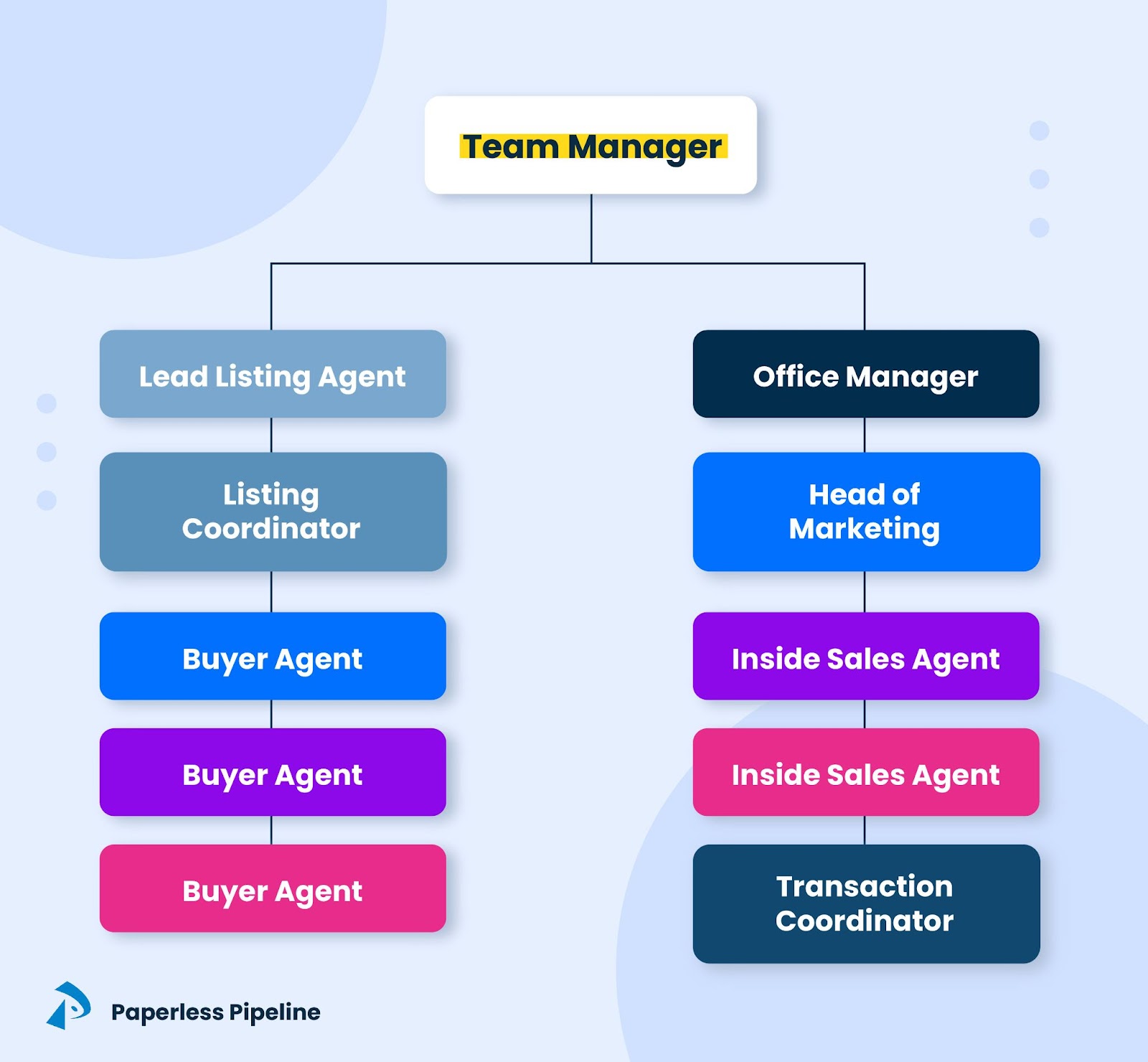
The significant number of leads coming in makes this structure highly scalable. However, each inside sales agent takes a cut of commissions, which means that this structure is typically only suitable for less experienced agents.
Commission Split
Your agents would earn around 50% commission, while inside sales earn 25%. This model also works well for flat-fee structures, as it encourages agents to take advantage of the high number of leads.
Pros
- Very high lead generation.
- Highly scalable.
Cons
- High costs, especially for the initial setup.
- 50% commission could make it difficult to hold on to more productive agents.
5. The Hybrid Model
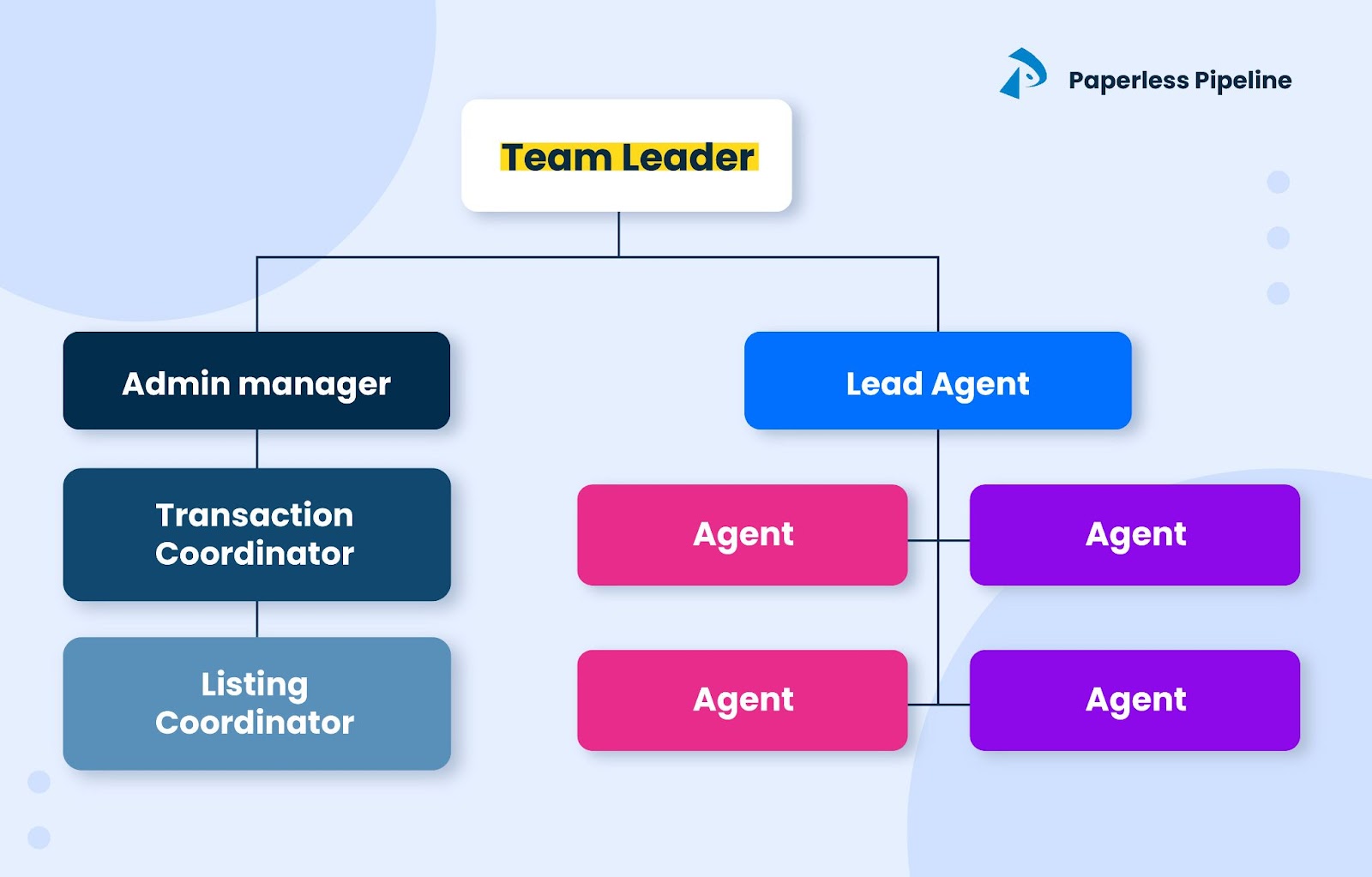
The word ‘Hybrid’ in this case doesn’t refer to the work-from-home phenomenon that has swept the world—a hybrid team is when your agents act as both buying and listing agents.
In the past, buyers’ agents and listing agents were separate teams. This was usually to avoid a conflict of interest and prevent agents from focusing solely on listings.
The problem is that most agents don’t want to be limited to just doing buyer deals. They want access to more lucrative listing opportunities, too. If they can’t get them, they will eventually move on to another real estate business.
This structure attracts and retains more experienced agents. However, extensive management is also required to ensure that the buyer and listing opportunities are evenly distributed.
This is usually a good option if your team leader or expanded traditional real estate team structure gets more listing leads than they can handle.
A hybrid team structure would look like this:
Commission Split
The ideal split in this case would be 50%, although more experienced agents might try and negotiate a better deal for themselves. A flat fee may also be a good option in this structure.
Pros
- Attract top agents.
- Handle a large number of listing leads.
Cons
- Lead distribution needs to be well-managed.
- You could end up paying higher commissions.
6. The Large Traditional Model
If a hybrid model doesn’t feel like the right fit, you can continue growing your traditional team by introducing a third team to manage inside sales.
Like the team leader structure, your business will have a section dedicated to marketing and nurturing leads. But here, you also have a strong admin support function.
Here is an example of what your team’s structure could be:
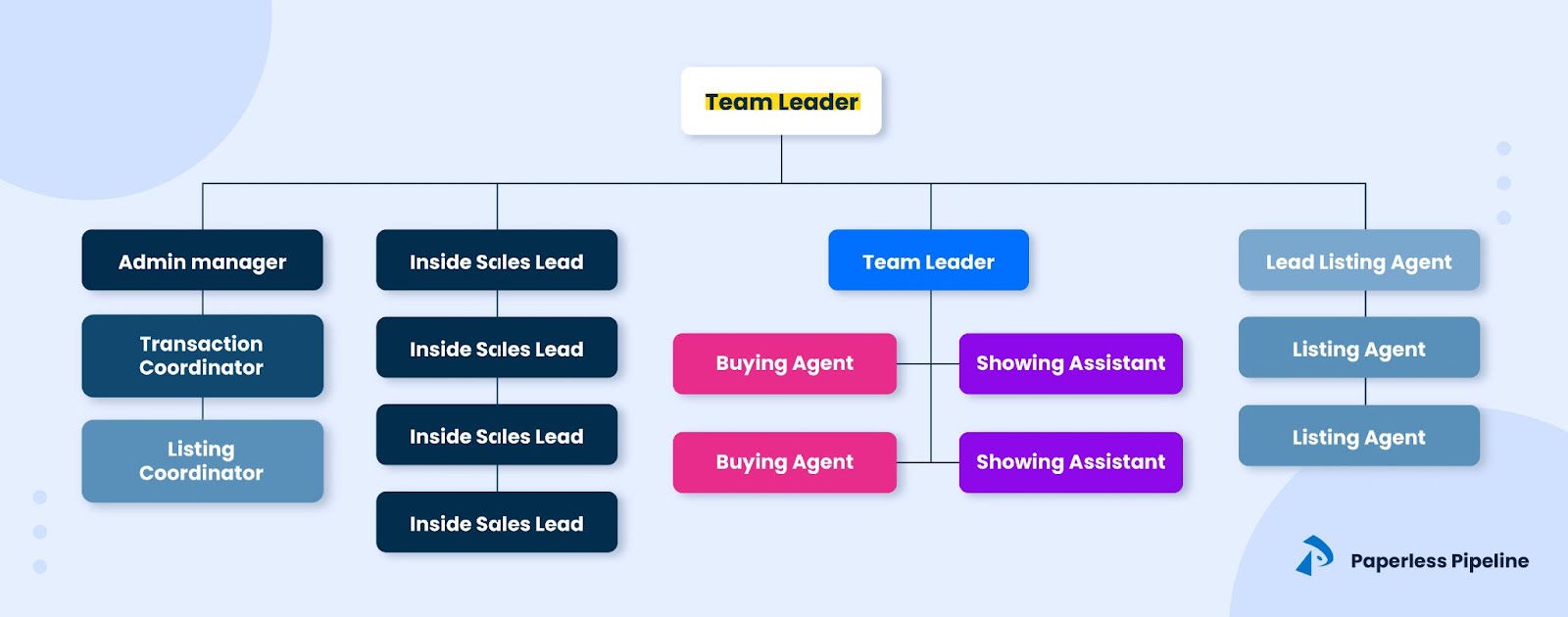
As an entire team dedicates itself to handling their respective part of the real estate process, you can close a significant number of deals. Inside sales bring in the leads, agents negotiate and sign deals, and transaction coordinators close the deals.
The pros and cons of this structure, and the commission splits, are largely similar to those found in the expanded structure. The only additional con is that you must account for inside sales commissions or fees. But your higher production rate should easily cover this.
Essential Tools for a Successful Real Estate Team

As you start your own successful real estate business, you’ll be kept busy with recruiting team members, training agents to do their best work, and getting your operations running efficiently.
Where will you find the time to do all this while still making the profit your hard work should earn you? By using the right software to support your business and processes.
Hundreds of real estate teams work with a transaction management tool, Paperless Pipeline.
Paperless Pipeline streamlines your transaction management process and saves many team leaders and agents hundreds of hours of time. Those hours can then be spent selling, generating leads, recruiting new team members, and growing your business.
We realize you may be wary about trying out new software in the early phases of your business. That’s why we’ll give you a free trial, no credit card required!
Frequently Asked Questions
Should my first hire be another agent or an admin? This is the most common question I get, and my answer is almost always the same: hire an admin first. It feels counterintuitive because agents are the ones who bring in revenue, but a great admin builds the foundation for your entire team. They create repeatable systems for transactions, manage paperwork, and handle the details that currently take up your time. This frees you up to do what you do best: generate leads and close deals, which is exactly what you’ll need to support the buyer’s agents you hire later.
How do I figure out the right commission split for my team? There’s no single magic number, but a good rule of thumb is that the commission split should reflect the value the team provides. If your team offers significant support like a steady stream of leads, full transaction coordination, and marketing resources, a 50/50 split is quite common. On the other hand, if you’re running a mentorship-style team where agents generate their own leads and handle their own paperwork, a split closer to 90/10 (in the agent’s favor) makes more sense.
I’m just starting out. Which team structure is best for a new team leader? For most agents looking to build a scalable business, the Small Traditional Model is the perfect starting point. It focuses on hiring an admin first, then adding a buyer’s agent once your lead flow increases. This approach lets you grow sustainably. If you’re looking for a lower-risk option without employees, the Mentor-Mentee Model is a great alternative. It allows you to guide new agents and earn a small portion of their commission without the overhead of a full team structure.
Do I really need to register my team with the state? Yes, you absolutely do. Most states have specific rules that define what a real estate team is and require you to register your team name with the real estate commission. This isn’t just about paperwork; it’s about professionalism and compliance. Registering your team ensures you’re operating legally under your supervising broker and provides clarity for consumers. Think of it as the official step that turns your group of agents into a legitimate business entity.
I’m worried I won’t have enough leads to support a team. What should I do? This is a completely valid concern, and it’s why focusing on systems is so important. If you’re already so busy with transactions that you don’t have time for consistent lead generation, that’s your sign that you need help. By hiring an administrative professional first, you buy back your time. That new time should be dedicated almost entirely to creating and executing a lead generation plan that can support not just you, but your future agents as well.
Key Takeaways
- Build your foundation before your sales force: Your first hire should be an admin, not another agent. Establishing strong operational systems from the start allows you to scale efficiently and frees you up to focus on high-value tasks like lead generation.
- Shift your mindset from top producer to team leader: To build a successful team, you must focus on empowering others. This means generating leads for your agents, mentoring them, and distributing opportunities to help them succeed, which ultimately grows the entire business.
- Choose your team model with purpose: Research your state’s legal requirements and select a team structure that fits your long-term vision. This decision impacts everything from commission splits to daily roles, so getting it right early on is crucial for sustainable growth.