How to Grow Your Real Estate Business Without the Chaos: Lessons from Industry Leaders
Paperless Pipeline’s Ricardo Bueno sits down with veteran broker Barry Jenkins to discuss how to grow your real estate business sustainably.
If you’ve been wondering how to grow your real estate business without losing control of your time or sanity, you’re not alone.
Real estate is fast-paced, competitive, and filled with people who thrive on closing deals.
But growth often feels like chaos. For every new listing or client win, there’s a new deadline to meet, a document to chase, or a late-night email that can’t wait until morning.
One productivity study estimates that real estate professionals spend around 28 percent of their week just managing their emails. Time that could be spent generating new listings or serving clients better.
To explore what sustainable growth looks like, Ricardo Bueno, Brand Ambassador at Paperless Pipeline, sat down with Barry Jenkins, a veteran broker, author, and nationally recognized team leader.
Between them, they’ve seen nearly every kind of real estate operation, including those that scale smoothly and those that buckle under pressure.
Their conversation wasn’t about working harder or chasing more leads. It was about building systems that create space for focus, efficiency, and better client experiences, without the burnout that often follows becoming a successful real estate business.
In this article, we’ll unpack the most valuable lessons from that discussion: practical, field-tested ideas to help you scale your business smarter, not harder, and grow with structure instead of stress.
The Scaling Problem: When Growth Creates Chaos

Growth in the real estate industry feels exciting—until it doesn’t.
Getting more listings, more clients, more revenue is great, but momentum can quickly turn into mayhem once the volume of work outgrows your systems.
Deals multiply, communication threads get longer, and what once fit neatly in an agent’s inbox now requires an entire team to manage.
Without structure, each success adds a little more stress.
Barry Jenkins describes this moment as “the tyranny of the urgent”: that constant state of reacting to whoever shouts loudest, instead of focusing on what actually drives the business forward.
As brokerages scale, the cracks begin to show:
- Missed deadlines jeopardize closings and client relationships.
- Overworked teams spend their days firefighting instead of building value.
- Lost files vanish into inboxes or shared drives, creating compliance risks.
- Declining client experiences follow as communication becomes inconsistent and trust erodes.
It’s frustrating and it’s expensive. A single missed inspection or delayed document can cost a deal. An overworked real estate agent who burns out can take months to replace.
Yet these problems rarely stem from lack of effort. In fact, many realtors spend hours on admin, follow-ups, and chasing information.
And this takes its toll. Most real estate agents end up spending less than 20% of their time on income-generating activities.
The emotional impact is just as real: late nights, constant pressure, and the nagging feeling that you’re always one step behind. Without structure, growth becomes chaos, and chaos doesn’t scale.
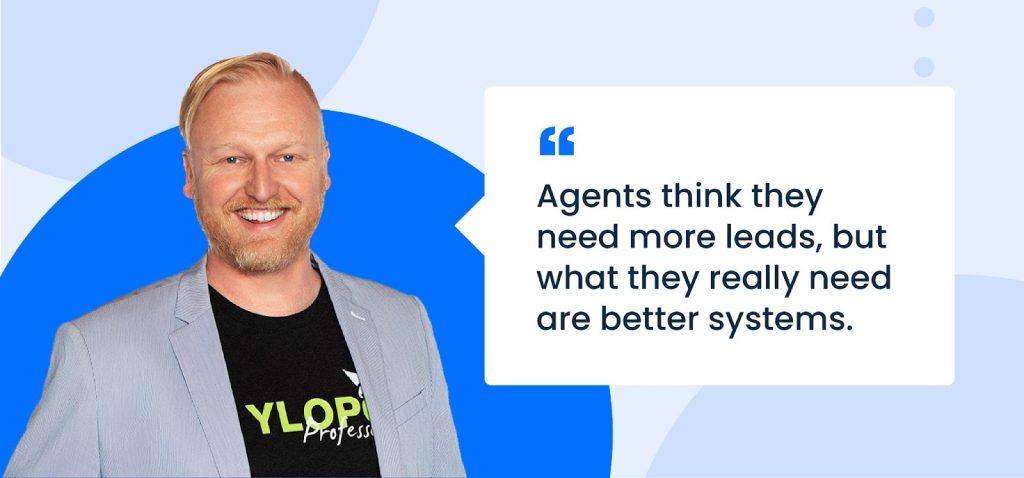
Barry has seen it many times before. “Agents think they need more leads,” he says, “but what they really need are better systems.”
Think about it: if you attract clients to a disorganized process, it only multiplies the chaos.
Growth, as Barry puts it, isn’t about doing more. It’s about doing the right things consistently with the right systems.
To achieve this in his own brokerage, he created a framework to help teams escape this cycle by replacing reactivity with clarity, structure, and consistency.
The Framework: Four Pillars of Sustainable Growth
After years of leading a top-performing brokerage, Barry Jenkins realized that slow growth often isn’t due to clients or a lack of talent. Instead, it’s due to disorganization.
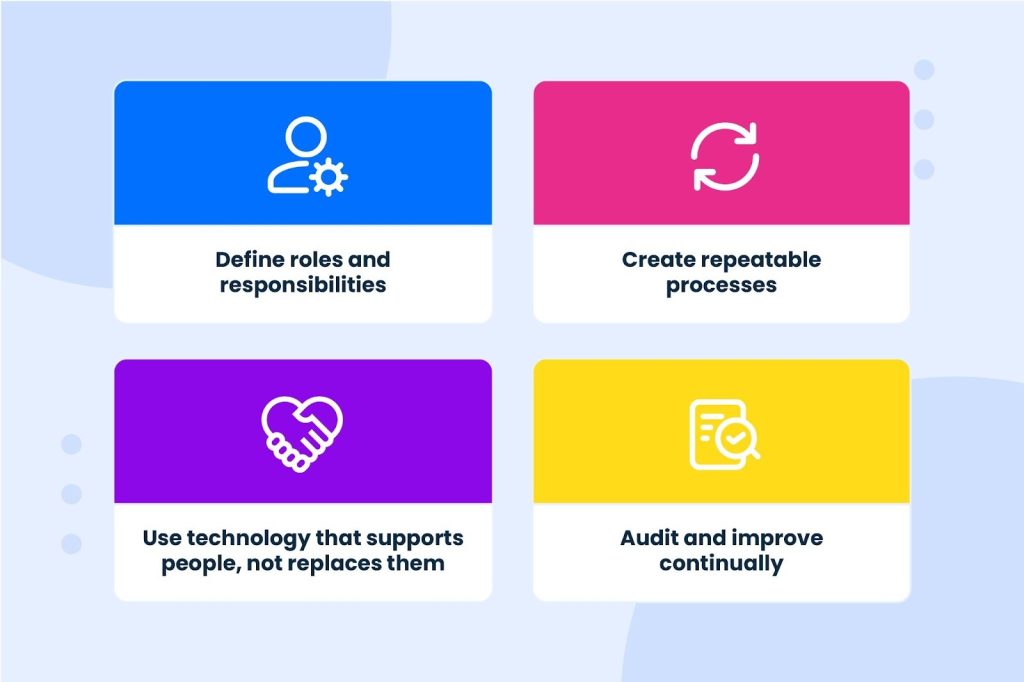
To fix that, Barry built a simple but powerful framework: four pillars designed to turn chaos into clarity.
These principles became the foundation of his brokerage’s operations, ensuring that every real estate agent knew what to do, when to do it, and how to do it efficiently.
Each pillar addresses a specific scaling challenge:
- Defining roles to eliminate confusion.
- Creating repeatable processes to reduce errors
- Using technology that empowers people.
- Continually auditing for improvement.
Together, they form the backbone of a business that can grow without breaking.
Pillar 1: Define roles and responsibilities
When a team grows quickly, clarity can disappear. Deals slow down because nobody is sure who’s handling what.
Emails bounce between admins and agents, tasks overlap, and critical items slip through the cracks.
Barry calls this “the fog of growth,” where effort is high but accountability is low.
In his early days as a team leader, that fog hit hard. As he scaled from three agents to dozens, he noticed the same pattern: unclear roles led to duplicated work and mounting stress.
Barry’s solution:
The first step to scaling is cutting through that fog. Barry mapped every role in his team, assigning ownership for each part of the transaction.
- Agents handled client relationships.
- Transaction coordinators managed documentation and deadlines.
- Admins oversaw compliance.
Suddenly, there were no gaps and no overlaps.
Understanding roles in this way is critical. For example, one study found that when real estate professionals aren’t clear about their responsibilities, they’re far more likely to leave their jobs.
Over time, Barry’s team saw fewer bottlenecks, fewer missed deadlines, and a smoother flow from listing to close.
Deadlines stopped being missed, and the team finally had time to focus on growth instead of firefighting.
Pillar 2: Create repeatable processes
Every real estate transaction feels unique, but in reality, most of the work is repeated.
Each real estate agent collects disclosures, schedules inspections, verifies documents, and coordinates with lenders repeatedly.
Barry explains that without consistent workflows, those repeated steps create confusion and delay. Everyone ends up reinventing the wheel on each deal.
Barry’s solution:
Barry documented every recurring task and built standardized checklists. Instead of keeping details in someone’s head, his team created one master process that applied to every transaction.
It gave each real estate agent a clear roadmap from listing to close and ensured nothing was missed.
This kind of structure has measurable benefits. Research shows that companies using clear standard operating procedures can operate up to 30 percent more efficiently because standardized workflows reduce errors and wasted time.
In the real estate industry, those efficiencies matter: a single transaction can include nearly 200 individual tasks, all bound by strict deadlines and legal requirements.
Barry’s takeaway was simple: once a process works, make it repeatable. Checklists don’t just prevent mistakes; they protect your team’s time and create a reliable client experience, no matter how fast the business grows.
Pillar 3: Use technology that supports people, not replaces them
Barry hears many real estate agents say they’re worried technology will replace the personal side of real estate.
His view is the opposite: the right tools don’t replace people, they make them more effective.
Automation handles the repetitive, low-value tasks that drain energy and focus. When those processes run in the background, agents can spend more time on tasks that add value, like:
- Communicating with clients.
- Negotiating deals.
- Nurturing relationships.
Across the real estate industry, this shift is already happening. Studies show that around 37 percent of real estate tasks could be automated, unlocking billions in efficiency gains, while teams that embrace automation can reclaim 10 or more hours per week to reinvest in growth.
Barry’s solution:
Barry’s team saw these benefits firsthand. By introducing structured systems, like a CRM system, integrations, automated checklists, and consistent transaction workflows, they reduced manual work and improved consistency across every client interaction.
Instead of spending time tracking paperwork or chasing signatures, agents could focus on service and strategy.
This approach enables people to perform at their best, which naturally creates strong relationships by increasing client trust and satisfaction.
Pillar 4: Audit and improve continually
Even the best systems can break under pressure if they’re never reviewed.
Barry says that if something repeatedly causes stress or slows your team down, fix the system, not the person. Every recurring issue is a signal that the workflow needs attention.
Barry’s solution:
Barry encourages brokers to step back regularly and look at where time and accuracy are being lost.
- Which parts of a transaction take longer than they should?
- Where are agents double-handling data or chasing missing information?
By auditing these friction points, a real estate broker can make minor adjustments that deliver massive efficiency gains. Barry calls this the “bottleneck method”.
Technology makes this kind of auditing far easier. Modern KPI dashboards and compliance alerts give brokers instant visibility into their operations.
As one report from InsightSoftware notes, tracking and analysing metrics “helps managers identify weaknesses and make better business decisions”.
Transaction Management: The Backbone of Growth
After defining roles and building consistent processes, Barry realized that true scalability required one more thing: to bring every deal, task, and document into a single, transparent system.
Transaction management became the backbone that held the entire business together, linking people, processes, and performance in one place.
The team realized three key benefits:
Complete visibility
With a centralized system, there was no longer a need for constant check-ins. Every stakeholder, whether that’s an agent, coordinator, broker, or client, could see exactly where each transaction stood at any moment.
Instead of endless “just checking in” calls, the information was already there, updated in real time.
Clear accountability
Barry started automatically assigning tasks to specific people and gave them clear deadlines, so follow-up became automatic. When everyone knows what they own, nothing falls between the cracks.
Consistent client experience
Every buyer and seller received the same high level of service. They got prompt updates, accurate paperwork, and on-time closings, no matter which team member handled their deal.
This kind of operational clarity is what Paperless Pipeline was built for. Its smart checklists, progress tracking, and compliance tools bring every transaction into one organized view.
When you can see the entire pipeline from contract to close, growth stops feeling chaotic, and starts feeling controlled.
“Transaction management isn’t just a tool, it’s the nervous system of your entire organization. Get this right, and everything else becomes easier.”
Barry Jenkins
From Chaos to Control: The Shift Every Brokerage Needs
Here’s a summary of the transition brokerages need to make to improve their management systems.
| Without Systems | With Systems |
| Critical documents are scattered across inboxes and drives | All files are centralized and instantly searchable |
| Unclear ownership, duplicated work, and missed tasks | Clear accountability: every task is assigned with deadlines |
| Last-minute scrambling before closings | Predictable, on-time closings for every transaction |
| Delayed commissions and frustrated staff | Prompt payouts and confident, focused teams |
| Inconsistent client communication | Consistent, high-trust client experience across every deal |
The Payoff of Smarter Operations
When Barry’s team started building structure into their business, the results spoke for themselves.
The same team that once felt constantly behind began to operate with calm, predictable efficiency.
According to Barry, the difference wasn’t in how hard his team worked, but in how well their systems worked for them.
With organized workflows and visibility across every transaction, they could focus on serving clients instead of chasing paperwork. “Success doesn’t come from hustle,” Barry explains. “It comes from systems that let you work consistently.”
Before: 60-hour weeks and fewer satisfied clients
Before Barry’s team restructured their operations, every day felt like damage control.
Important details were often overlooked, leading to missed deadlines and frustrated clients.
His business analytics reflected this:
⚠️ They managed roughly 35 active transactions at a time, mostly through emails, sticky notes, and mental checklists.
⚠️ Agents spent an average of 12 hours each week just searching for information, including old attachments, inspection reports, or unsigned documents buried in threads.
⚠️ Client complaints averaged three per week.
⚠️ Two deals fell through entirely because of missed milestones.
The team was putting in 60-hour weeks just to keep up, yet it always felt like they were one unexpected issue away from chaos.
After: From Firefighting to Flow
The shift began when they centralized their processes and built accountability into every stage of a transaction.
Checklists replaced sticky notes, tasks were assigned to specific people, and documents lived in one shared system accessible to everyone.
The difference was dramatic. Within months, the team had:
✔️ Managed 85 active transactions seamlessly.
✔️ Spent zero time searching for files.
✔️ Received less than one complaint per month from its client base.
✔️ Achieved a 100% on-time closing rate for 18 consecutive months.
✔️ Reported 65% less work-related stress.
Most importantly, the team returned to standard 40–50-hour workweeks without losing momentum.
Operational health drives productivity, but it also drives morale. When your team feels supported by strong systems instead of overwhelmed by them, they work with clarity, confidence, and consistency.
That’s the real payoff of smarter operations: a business that grows without burning out the people who make it possible.
Barry sums it up simply: when your systems run smoothly, your team can too. The chaos didn’t disappear by working harder; it disappeared by creating structure. That transformation from firefighting to flow is what true scalability looks like.
Practical Steps You Can Implement Today
You don’t need to overhaul your entire operation to achieve the same results as Barry. Minor, consistent improvements can have an immediate impact on how your team works and how your clients experience your service.
Here are four simple actions Barry recommends that any brokerage can start implementing this week:
- Build a master checklist: Create one comprehensive checklist for every transaction type: listing, buyer, or rental. Standardizing your process can reduce missed tasks by up to 70% in the first month, simply by making responsibilities visible and repeatable.
- Centralize all documents: Stop storing files in email threads and desktop folders. Use a single, shared platform so everyone knows exactly where to find what they need. This can cut document search time from minutes to seconds and prevent critical items from being forgotten.
- Implement real deadlines: Don’t wait until the day something is due. Set internal deadlines two to three days earlier than external ones. This buffer ensures last-minute surprises never derail a closing.
- Hold weekly team check-ins: A focused 30-minute meeting once a week keeps everyone aligned on upcoming deadlines and potential bottlenecks, so problems get solved before they reach the client.
These simple habits create quick wins that build momentum. Even before full system adoption, they’ll make your brokerage calmer, your clients happier, and your team more productive.
From Framework to Execution: How Software Makes It Work

Barry’s four pillars of clarity, consistency, technology, and improvement are a playbook that works best when powered by the right tools.
As Barry puts it, “You’ve got to let go to grow.” Letting go means trusting systems that make your process visible, repeatable, and reliable. That’s where technology steps in.
Transaction management software allows you to turn his framework into action. It gives every team member clear ownership, automates routine tasks, and ensures each deal moves forward on schedule. The result is a brokerage that runs on structure, not stress.
If you’ve been searching for how to grow your real estate business sustainably, start by building systems that support your people, reduce the daily chaos, and give you room to lead.
Streamline Your Growth with Paperless Pipeline
Barry’s approach works because it’s practical, and with the right software, it’s scalable.
Paperless Pipeline turns his framework into something any brokerage can put into practice.
It gives your team complete visibility across every deal, assigns accountability with clear deadlines, and automates the repetitive admin that slows growth.
Instead of chasing documents or checking status updates, your team can focus on what really drives revenue: serving clients and closing more deals.
From smart checklists that standardize your workflows to real-time compliance tracking that prevents costly mistakes, Paperless Pipeline gives you the structure that sustainable growth depends on.
Start your free trial today and experience how much smoother your business runs when your systems handle the busywork, so your people can focus on performance.

Ready to simplify your process and delight your agents?
In less than a minute you can start testing the newest features built to help your entire office close more deals. It’s simple, powerful, and 100% free to try without a credit card.
Try it free →