A Comprehensive Buyer’s Agent Checklist: 3 Amazing Free Samples To Keep You Organized

We know it’s tough to be a buyer’s agent. You’re constantly managing multiple tasks from meeting clients, and checking the multiple listing service (MLS) for suitable properties, to attending viewings, and negotiating deals. Each of these tasks takes time, and the market you’re operating in rarely slows down.
On top of that, there’s the competition. If the real estate industry is hot, the best properties often attract multiple offers. If your clients’ offer isn’t accepted, you don’t get paid, and the cycle starts all over again.
It’s no surprise that nearly 89% of buyers now choose to work with a buyer’s agent in 2025, according to the National Association of Realtors. Buyers depend on you not only to help them secure the right home but also to guide them through an increasingly complicated process.
However, with so many documents, deadlines, and details involved in closing a deal, even one missed date or misplaced file can delay or derail a deal.
The key is to simplify your system. A structured checklist ensures that nothing slips through the cracks, giving both you and your clients peace of mind.
In this article, we’ll share three buyer’s agent checklist templates you can start using right away to stay organized, improve your time management, and close more deals successfully.
Why a Buyer’s Agent Checklist Is Helpful
Most of the buyer’s checklists you can download for free focus on the real estate sales process. In other words, bringing clients in, helping them with house hunting, and assessing multiple homes.
But most buyers’ agents don’t need a checklist for this. They love finding properties for their clients and are good at it.
However, very few enjoy the closing process, which is the period that starts when the contract is signed and ends when the deal closes.
It involves a lot of paperwork, and things are most likely to go wrong if a buyer’s agent is disorganized.
The checklists in this article have been designed to help buyer’s agents keep each deal progressing as it should after their client’s offer has been accepted.
One real estate firm saw a huge return on investment (ROI) when it began using checklists in commercial property sales. The checklists helped them ensure that no critical steps were missed and improved discipline within the brokerage, with it reporting a 30% reduction in operational risks.
A buyer’s agent checklist can help you to:
Stay organized
Many agents think they can move on to the next client once an offer has been accepted. But the next stage is just as critical.
If you miss key dates or lose documents, your real estate deal can be delayed or even fall through. This not only costs you money but also damages your real estate career and reputation.
Using checklists ensures you know what needs to be done and when. It also means that anyone else involved in the deal, like your broker or transaction coordinator, can see what stage it is at.
Save time
There’s no bigger waste of time than sifting through notes and emails trying to remember what stage a deal is at.
Syncing your checklist with your calendar lets you see exactly what you need to do that day to keep the deal moving forward.
Predict revenues
Knowing the different stages a deal needs to go through before it closes can help you predict when you will get paid. You can also predict how likely a deal is to fall through.
For example, a deal that is in its final walk-through stage is nearly complete, so there is little risk of a critical issue, and you will likely close the deal in a week.
But if an offer has only just been accepted, there is still a long way to go, and any number of issues could arise before you’re making commissions and driving revenue.
The Real Estate Buying Process Explained
Before we give you some examples of buyer’s checklists, here’s a basic overview of the real estate buying process:
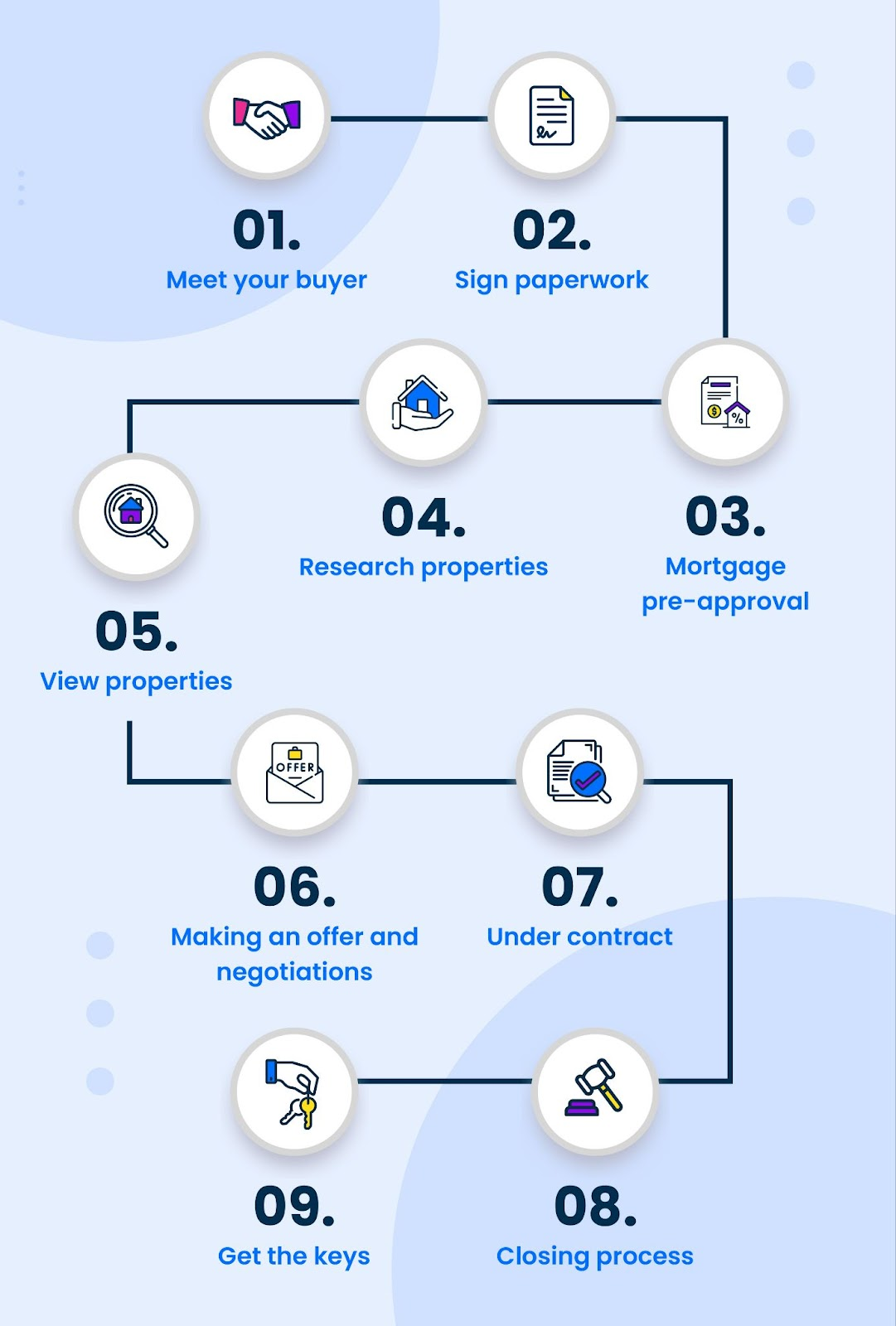
1. Meet your buyer
The first step is sitting down with your client to understand their needs. This initial meeting, which is often around 30 minutes to an hour, is where you build rapport and set expectations.
Use it as an opportunity to ask questions about their lifestyle, preferred neighborhoods, must-have property features, and their budget.
This is also your chance to explain how you work as a buyer’s agent, what services you’ll provide, and how you’ll guide them from search to closing.
2. Sign the paperwork
Before you start spending hours on property searches, it’s vital to make sure all the essential paperwork is signed. This includes your buyer agency agreement and any required disclosures in your state.
Getting this step done upfront ensures you’re legally protected and that both you and your client are on the same page regarding responsibilities, timelines, and your commission.
It also looks professional, as you’re showing your client that you’re taking their transaction seriously and have a structured process in place.
3. Mortgage pre-approval
Encourage your clients to secure mortgage pre-approval before beginning the house hunt. A pre-approval letter gives them a clear picture of their budget, helps narrow the search to realistic properties, and strengthens their position when it’s time to make an offer.
In competitive markets, sellers often won’t consider offers without pre-approval, so guiding your clients through this step early saves time and increases their chances of success.
4. Research properties
Once the financial basics are in place, it’s time to begin the property search. Use the MLS, your network, and off-market opportunities to create a tailored shortlist of homes that meet your client’s criteria.
Go beyond the basics and consider commute times, school districts, the future resale value, and neighborhood amenities.
Share your curated list with your clients and highlight the pros and cons of each property. A thorough research stage not only helps clients feel confident but also positions you as their trusted advisor.
5. View properties
Property showings are opportunities to educate your clients. Accompany them to property viewings and point out both appealing features and potential red flags, such as outdated electrical wiring, structural issues, or costly repairs.
Listening carefully to their reactions will also help you refine your search further. Sometimes, buyers don’t know exactly what they’re looking for until they’ve seen a few properties, so these visits are important in clarifying their preferences.
6. Making an offer and negotiations
If your buyers like a property, you can advise them on a suitable offer. You may want to conduct a comparative market analysis (CMA) to ensure your buyers are offering a fair amount.
If they agree, send their offer to the seller’s agent. They will either accept it, reject it, or make a counteroffer.
You can then make another counteroffer on behalf of your clients. This process can continue until an offer is accepted or rejected.
7. Under contract
If the seller accepts your client’s offer, the property is considered “under contract.” This is an exciting milestone, but it’s also where the real work begins.
Deadlines are now legally binding, and missing one could jeopardize the entire deal, which is why checklists are so helpful.
At this stage, you’ll coordinate with lenders, attorneys, inspectors, and the seller’s agent to keep everything on track.
The closing process
The closing process is the most detail-heavy part of the transaction. Several critical tasks must be completed within specific timeframes, including:
- Scheduling and reviewing home inspections.
- Conducting a title search to ensure there are no ownership disputes.
- Removing contract contingencies (such as financing or appraisal).
- Securing home insurance for the buyer.
- Negotiating repairs or credits based on inspection results.
Each of these steps has the potential to cause delays or derail the deal if not managed properly. A closing checklist is essential here as it keeps you organized and ensures nothing slips through the cracks.
8. Get the keys
Finally, after all documents are signed, funds are transferred, and every condition has been satisfied, the buyer gets the keys. This is the culmination of weeks (or sometimes months) of work and is one of the most rewarding moments for both you and your clients.
3 Buyer’s Agent Checklists to Use

Each of these checklists takes a different approach to the transaction management process.
You can choose whichever one works best for you, but we recommend customizing them to suit your way of working.
Many buyers, especially first-time buyers, won’t know what’s expected of them during the buying or closing process.
This is why it’s a good idea to meet with your buyers before viewing any properties, and go through the checklist to explain the buying process and what they can expect.
A checklist will ensure they understand the urgent stages, allowing them to prepare the relevant information on time.
1. Pending buyer checklist
This buyer checklist example is tailored to suit real estate teams. It includes two tasks relating to approving a mortgage loan, which could be something you provide as a service.
| Task | Relative due date |
 Send contract timeline to buyers Send contract timeline to buyers | 1 calendar day after the acceptance date |
| Send buyers a list of home inspectors | 1 calendar day after the acceptance date |
| Earnest money deposit check | 2 calendar days after acceptance date |
| Schedule home inspection | TBD |
| Fully signed contract with buyers | TBD |
| Lead-Based Paint Disclosure signed by seller and buyers (if applicable) | TBD |
| Conditional loan approval due (if financing) | TBD |
| Final loan approval due (if financing) | TBD |
| Send utility list to buyers | 5 calendar days after the acceptance date |
| Confirm the closing date and time with the client | 7 calendar days before the closing date |
| Send gifts to buyers | On close date |
2. Pending documents checklist
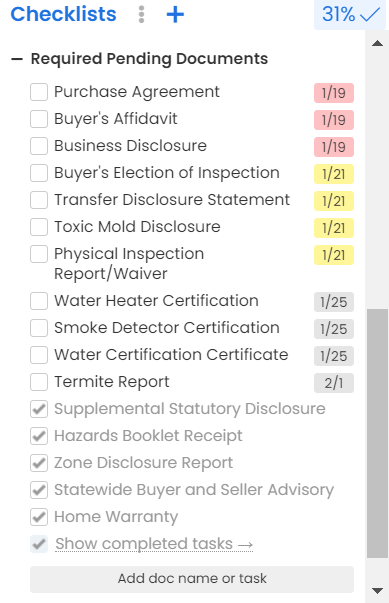
This buyer checklist example features several tasks related to the paperwork required for a pending transaction. Keep in mind that different states require the completion of various forms. It is always a good idea to check with your state to see what forms you need.
| Task | Relative due date |
| Agency Disclosure | 1 calendar day after the acceptance date |
| Business Disclosure | 1 calendar day after the acceptance date |
| Buyer’s Affidavit | 1 calendar day after the acceptance date |
| Purchase Agreement | 1 calendar day after the acceptance date |
| Physical Inspection Report/Waiver | 3 calendar days after acceptance date |
| Toxic Mold Disclosure | 3 calendar days after acceptance date |
| Transfer Disclosure Statement | 3 calendar days after acceptance date |
| Buyer’s Election of Inspection | 3 calendar days after acceptance date |
| Water Certification | 7 calendar days after the acceptance date |
| Smoke Detector Certification | 7 calendar days after the acceptance date |
| Termite Report | 14 calendar days after the acceptance date |
| Home Warranty | 21 calendar days after the acceptance date |
3. Contract-to-close checklist
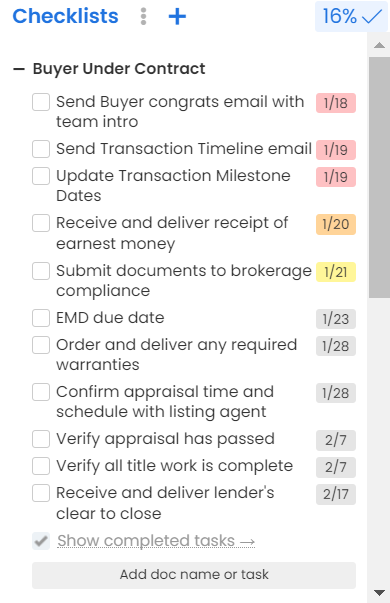
Once a seller and the listing agent have accepted an offer, a contract is signed, and the closing process begins. As mentioned above, it’s also the stage where mistakes can creep in and cause a transaction to fall through. This checklist is designed to help you avoid missing any critical milestones that could impact the closing of your deal.
| Task | Relative due date |
| Additional deposit due | 2 business days after the acceptance date |
| Buyer to submit the loan application | 3 business days after the acceptance date |
| Buyer initial deposit to escrow or title company | 3 business days after the acceptance date |
| Seller to deliver a list of inventory to the buyer | 5 business days after the acceptance date |
| Verification of cash funds (if applicable) | 5 business days after the acceptance date |
| Pre-qualification letter due | 5 business days after the acceptance date |
| Buyer inventory review period ends | TBD |
| Seller’s Disclosure delivered to buyer | 10 business days after the acceptance date |
| Buyer Acknowledgement of Receiving Seller’s Disclosure | 10 business days after the acceptance date |
| Property Inspection Completion by the buyer | 14 business days after the acceptance date |
| Title search and tenancy due | 15 business days after the acceptance date |
| Seller’s disclosure review period ends | 15 business days after the acceptance date |
| Conditional Loan Commitment Letter (if applicable) | 15 business days after the acceptance date |
| Survey (if applicable) | 14 business days before the closing date |
| Satisfaction of lender’s conditions | TBD |
| Final walkthrough by buyer | 5 business days before the closing date |
| Seller removal of items from property | 5 business days before the closing date |
| Interior/exterior cleaning | 5 business days before the closing date |
| Scheduled closing date | On close date |
| Home inspection schedule date | TBD |
| Survey schedule date | TBD |
| Termite inspection date | TBD |
| Condo Documents order date | TBD |
| Appraisal Date | TBD |
9 Tips for Better Buyer Checklists
Now that you’re equipped with these checklists, here are some expert tips to help you get the most from them:
1. Personalize your checklists
Whether you’re using one of the checklists above or tech tools like Paperless Pipeline, be sure to adjust each checklist so it suits the individual client, agent, property, and the current market.
For example, the transaction process for a new buyer purchasing a small city-center apartment will be very different from someone buying a 30-acre ranch via foreclosure.
2. Talk your clients through your checklists
Many clients are unsure of what to expect from the real estate transaction process. Your checklists are a useful guide to walk them through each stage of the buying process. You can tell them what will happen, what they need to do, and by when.
This prepares your clients and ensures that there are no surprises. Knowing deadlines and important milestones will help them complete their contributions to the deal, such as signing documents, on time.
3. Use checklists to understand your clients’ dream homes
Checklists don’t just need to guide you through transaction processes. They can also help you determine what type of home your client desires.
Include things like:
- Price range.
- Type of property.
- Number of bedrooms.
- Number of bathrooms.
- The number of other rooms.
- Size of kitchen.
- Size of garden.
- Do they want a drive?
- Do they want a garage?
- Should there be a pool?
- Do they want any outbuildings?
4. Create a checklist to record client reactions
Checklists can also record your clients’ reactions after seeing your prospective properties.
As you take them around the property, check off everything they like about it. You can also list more abstract factors, like first impressions and value for money.
5. Talk about inspections early
You need to act fast to complete inspections, so it’s a good idea to have a separate checklist for this and talk your clients through it. The inspection should include questions like:
- Is the home well-insulated?
- Are there drainage issues?
- Are the electrical components safe?
- Is the plumbing in good condition?
- Is the boiler in good working order?
- Is there any damp or mold present?
- Are the foundations solid?
6. Check in on your clients’ progress
Some parts of your checklist will depend on your clients taking action. Don’t assume they will meet deadlines. They are just as likely to lose paperwork or miss critical milestones.
Give them a friendly call a few days before the deadline to make sure they have everything they need and are still on track to submit it.
7. Partner with lenders
As mentioned earlier, getting a mortgage pre-approval letter is an important step on your checklist. You can speed up this stage and provide better service for your clients by partnering with a local mortgage broker or lender.
This presents a lead-generation opportunity for both parties. By partnering with a lender, you can offer finance to your clients, and they can recommend your real estate agent services to their finance customers.
8. Partner with a closing company
Partnering with a title company allows you to recommend a trusted business to clients. But there’s also another benefit: getting their expertise in submitting documents and meeting deadlines will help develop a more efficient process.
For example, they will know many common title issues and will be able to help you create a checklist that avoids them.
9. Be specific about tasks
Be as granular as possible when it comes to adding tasks to your checklist, as this ensures there is no confusion and nothing gets missed.
Think about each step and task that each person involved in the transaction needs to take.
For example, a home inspection involves many steps, like attending the inspection, reviewing the inspection report, asking questions, approving the report, and sending off the approved report.
How a Real Estate Professional Can Use Checklists to Boost Their Business

Simply having a checklist isn’t enough, especially if you host it on a spreadsheet.
For example, what happens when you have hundreds of things to do on those busy days? How can you guarantee that you’ll remember to look at your checklist?
What happens if you download a copy to use on the road? Can you guarantee that you can update the master copy at the office?
To help with this, you need a transaction management system built around your checklists, like Paperless Pipeline.
Our transaction management software organizes each deal around a checklist (or multiple checklists). This becomes the heart of your real estate business, helping drive every deal toward completion.
Here’s how our checklists help keep you on track:
- Your checklists sync with emails and calendars, providing daily task reminders and to-do lists that ensure you don’t miss deadlines.
- Checklists can be automatically applied every time you open a new transaction. This allows you to instantly auto-populate due dates and reminders in your calendar, saving you time.
- The checklist acts as a single source of truth. If a task is checked off the list, you (and any team members working with you on the transaction) can be confident it has been completed.
- Paperless Pipeline can be accessed from any device, allowing you to manage tasks seamlessly from anywhere.
Speed Up Your Clients’ Home Buying Process with Paperless Pipeline
Being a buyer’s agent is demanding. You’re balancing multiple clients, competing offers, and a mountain of documents, all while making sure nothing goes wrong.
Without a clear system in place, it’s easy for deadlines to slip, deals to stall, or important details to get lost. This is frustrating for both you and your clients.
That’s why using structured checklists is essential. They streamline every step of the process, keep you organized, and give your clients confidence that their transaction is in capable hands.
Tools like Paperless Pipeline’s automated checklists can reduce stress, save time, and increase your chances of closing deals successfully.
Sign up for a free trial of Paperless Pipeline to discover more powerful checklists and access tools to use them more effectively.